In 1980, my world in Detroit began behind the heavy doors of 850 Whitmore. Entering the building felt like stepping into a more refined era; the lobby’s polished marble floors reflected a quiet, historic charm that stood in stark contrast to the “institutional” high-rises nearby. My home was an efficiency unit, a masterclass in urban utility where a Murphy bed allowed me to transform my sleeping quarters into a social space with a single tug.
Living there as a young Caucasian queer person, the rent was surprisingly accessible, yet the environment felt like a luxury sanctuary. From the beautiful wood floors of my duplex-style layout to the “Chicago-style” windows overlooking the Palmer Park Apartment Building Historic District, 850 Whitmore was the anchor of my daily life. It was the place where I’d prepare for the evening before walking a few short blocks down to the Gold Coast Saloon on McNichols, where legends like Wanda Sione waited to greet a neighborhood that felt—for a brief, golden moment—entirely our own
Chapter: 850 Whitmore
Sub-title: Room, Locker, and the Marble Lobby
From the vantage point of this later season in my life, the summer of 1980 feels less like a memory and more like a fever dream of liberation and labor. I was a young man from the Bible Belt, freshly planted in the Palmer Park Apartment Building Historic District. My world was anchored by 850 Whitmore, a boutique gem designed by I.M. Lewis. It had a grand marble entryway that whispered of a sophisticated urbanity I had never known back home. Inside my efficiency, a Murphy bed was my primary piece of furniture—a clever bit of stagecraft that allowed my small room to breathe during the day.
But if 850 Whitmore was my sanctuary, my job that summer was my education.
I worked as an attendant at a local gay bathhouse (perhaps the Body Works or the Club Detroit). In an era of a struggling Detroit economy, the pay was surprisingly generous—certainly better than minimum wage—but the real currency was the company. For a boy from the Bible Belt, being surrounded by gay men was Nirvana. I was the gatekeeper, buzzing patrons in for safety and reciting the liturgical greeting of the era: “Room or a locker?”
A locker was $3; a room was $7.
I was naive then. I remember the sharp, silent sting of seeing so many wedding rings on the hands that reached out to pay me. It was my first glimpse into the hidden, partitioned lives men were forced to lead.
The job was gritty. I spent my shifts laundering endless sheets and scrubbing the “dreaded orgy room”—a daily ritual of cleaning up after the visceral, anonymous release of hundreds. While I believed then, and still believe now, that sexual liberation is a wonder, that summer taught me something essential about myself. I realized I was demisexual. Amidst the steam and the heavy scent of chlorinated sex, I discovered that I needed the tether of love—or at least the beautiful illusion of it—to feel desire. In the bathhouse, no one was pretending. It was sex as a transaction of relief, void of the romance I was so hungry for.
After my shifts, I would walk back to the quiet dignity of Whitmore Road. I’d pass the Gold Coast Saloon, where Christina Collins might be holding court, and slip back into my marble-floored lobby. I was an elderly man in training even then—observing, feeling the poignancy of our shared secrets, and looking for a connection that a $7 room could never provide.
The Walk: From Wanda to Jennifer
After my shift, the walk home was a pilgrimage through the heart of the district. I’d head toward the Gold Coast Saloon (2985 W. McNichols), the neighborhood’s “living room.” While legends like Christina Collins were always there, it was Wanda Simone I really knew—a fixture of the community who felt like home.
But the air that summer belonged to one person. In the bars, the greeting wasn’t “How are you?” it was: “Have you seen Jennifer?”
Jennifer Foxx (known to me then as the beautiful Bobby Bruno) was our rising star, a Miss Gay America hopeful who made Detroit feel like a glamorous stage. I fancied Bobby then. He was a beautiful boy, the kind of “celebrity” you wanted to fall in love with. To see him transform into Jennifer was to witness a masterpiece in motion. We’ve since reconnected on Facebook, and telling him now that I wanted to bed him back then feels like a sweet, honest confession from a different lifetime.
The Final Turn: The Gas Station
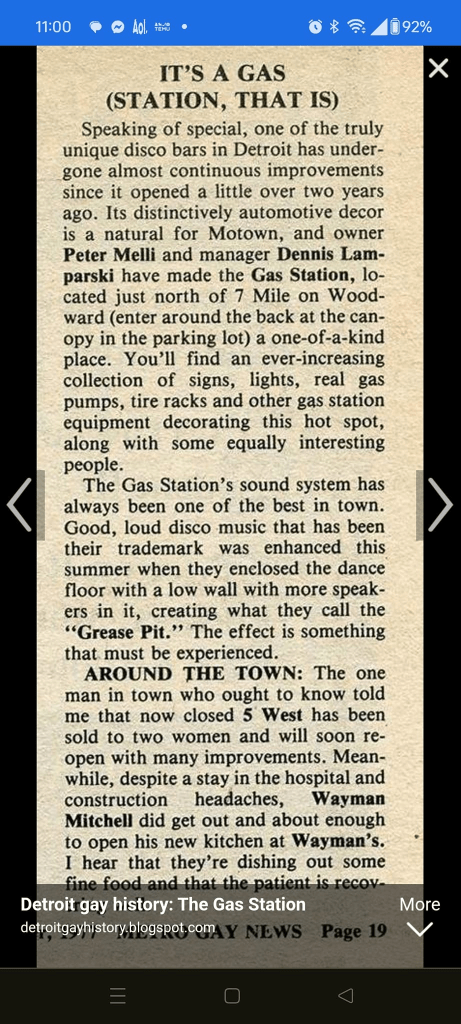
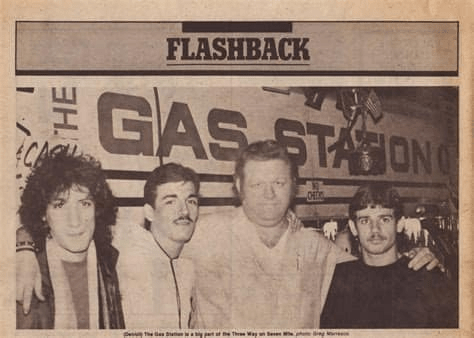
The night usually ended further down the street at The Gas Station. It was a bar like no other, featuring a famous sunken dance floor and stadium-style seating. I would sit there, watching the community move to the heavy JBL bass, before finally walking back to the quiet dignity of 850 Whitmore. I’d slip past the marble lobby, fold down my Murphy bed, and tuck my Bible Belt memories away for one more night.
 Site Title
Leave a comment